Israel, America, and the Kingdom of God
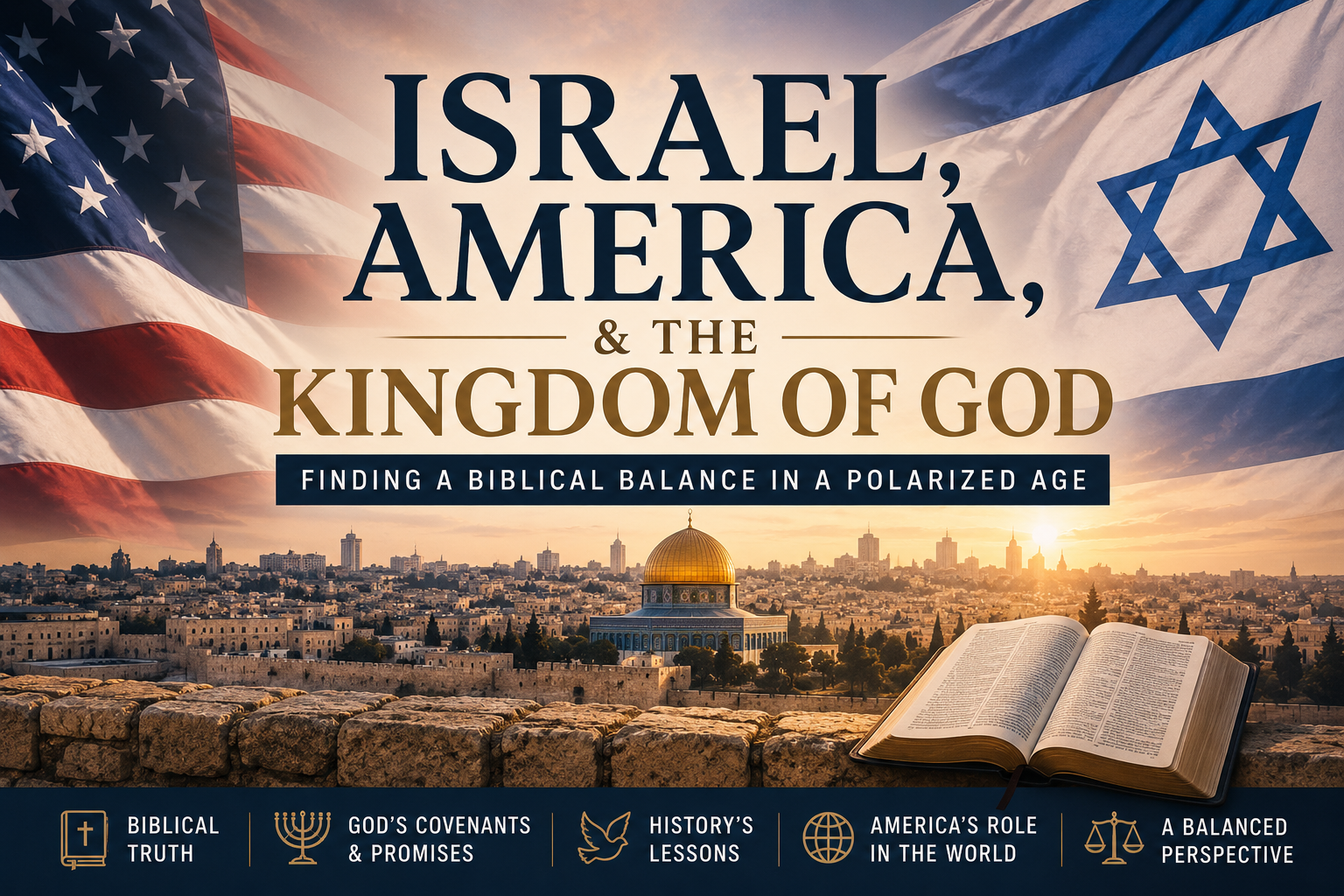
Finding a Biblical Balance in a Polarized Age
Few topics generate more controversy among Christians today than the relationship between faith and politics, the role of America in God's purposes, and the ongoing significance of Israel in biblical theology.
In an age of social media soundbites and ideological extremes, many believers feel pressured to choose between competing narratives. Some entirely spiritualize these issues, while others reduce them to political talking points. Yet Scripture calls us to a deeper, more nuanced approach rooted in covenant, history, theology, and the lordship of Jesus Christ. Much of the modern conversation is shaped by personalities, pundits, and viral clips rather than careful biblical study. Christians should be cautious about forming convictions from soundbites alone. These subjects deserve thoughtful engagement with the whole counsel of God.
As Christians, our ultimate allegiance is not to a political party, a nation, or an earthly movement. Our allegiance belongs to Christ and His Kingdom. Yet that does not mean questions about government, culture, and Israel are unimportant. The Bible speaks to all of these realities and provides a framework for faithful engagement.
Christians, Government, and Public Life
First, we must address one of the most misunderstood concepts in modern American culture is the phrase "separation of church and state."
While often used to suggest that religious conviction should be excluded from public life, the historical context tells a different story. The phrase itself does not appear in the Constitution. It originated in a letter written by Thomas Jefferson to the Danbury Baptists in 1802, where he sought to reassure them that the federal government would not establish a national denomination or interfere with the free exercise of religion.
The founders had witnessed European systems where governments controlled churches, appointed clergy, taxed citizens into state religions, and persecuted dissenters. The American experiment was designed differently. The goal was not to protect the state from Christianity but to protect the church from government control.
Throughout American history, biblical principles, public prayer, religious liberty, and moral conviction played significant roles in shaping public institutions. Many of the founders openly believed that virtue, morality, and religion were essential to preserving liberty. Congress opened in prayer. Presidents called for national days of prayer and fasting. Early public education relied heavily on biblical instruction. Church services were even held within government buildings during the nation's early years.
The biblical question is therefore not whether Christians should influence society. The biblical question is how they should do so.
Scripture consistently presents God's people influencing nations and leaders:
Joseph served in Egypt.
Daniel advised kings in Babylon.
Esther intervened on behalf of her people.
Nehemiah served in government.
John the Baptist confronted political leaders.
Paul reasoned before governors and kings.
Christians are called to be salt and light in every sphere of society, including government, education, business, media, and culture. However, the Kingdom of God does not advance through coercion. It advances through truth, discipleship, evangelism, sacrificial love, and faithful witness.
America Is Not the Kingdom of God
Christians should love their nation, pray for its leaders, and seek its flourishing. Gratitude for one's country is entirely compatible with biblical faithfulness.
America has been used in remarkable ways throughout history to advance religious liberty, humanitarian aid, missions, and the spread of the Gospel. These contributions should be recognized and appreciated.
At the same time, no nation occupies the place of God's eternal Kingdom.
Jesus is not returning for a political party. He is returning for His Church.
Patriotism becomes dangerous when it evolves into hyper-nationalism that places national identity above Kingdom identity. Christians must resist the temptation to equate God's purposes with the success of any earthly government.
Nations rise and fall. Empires come and go. Christ's Kingdom alone is eternal.
Our citizenship is ultimately in heaven.
Israel and the Covenants of God
One of the most debated questions in modern theology concerns the relationship between Israel and the Church.
Some Christians hold that the Church has entirely replaced Israel in God's redemptive plan. This view is commonly called Replacement Theology or Supersessionism.
Others believe God's covenant promises to Israel continue to hold significance while finding their ultimate fulfillment in Jesus Christ.
The foundation of this discussion begins with understanding the covenants.
The Abrahamic Covenant predates the Mosaic Covenant by centuries. While the New Testament teaches that the Mosaic Covenant has been fulfilled and rendered obsolete through Christ, the Abrahamic Covenant remains foundational to the biblical story.
God promised Abraham:
A land
A people
A blessing
That all nations would be blessed through his offspring
The New Testament reveals Jesus as the ultimate fulfillment of these promises. Through Him, salvation has been extended to every nation, tribe, and tongue. But this does not mean Israel has no part to plan in the unfolding plan of God.
The expansion of God's covenant blessings to the Gentiles does not require the erasure of Israel.
The New Covenant fulfills God's promises. It does not nullify God's faithfulness.
The Significance of Romans 11
Perhaps no chapter addresses this issue more directly than Romans 11.
The Apostle Paul asks:
"Has God rejected His people?"
His answer is emphatic:
"By no means."
Paul warns Gentile believers against arrogance toward Israel and uses the imagery of an olive tree. Gentiles are described as wild branches grafted into the rich root of God's covenant purposes.
The message is clear: being grafted in does not mean the original branches have become irrelevant.
Paul further describes Israel as beloved because of the patriarchs and reminds believers that "the gifts and calling of God are irrevocable."
Whatever one's eschatological framework may be, Romans 11 demands humility, gratitude, and caution toward any theology that minimizes God's historical relationship with Israel.
Paul does not present the Church as replacing Israel. Rather, he presents believing Gentiles as being graciously included in God's redemptive plan through Israel's Messiah.
Why Israel Is Unique
One of the most common objections raised in conversations about Israel is this:
"Why should Israel be treated differently than every other nation?"
The answer is not that Israel is more valuable than other nations, nor that Jewish people are somehow more loved by God than anyone else. The Gospel is offered equally to Jew and Gentile through Jesus Christ.
However, Scripture clearly teaches that Israel occupies a unique covenantal role in redemptive history.
A helpful analogy is how we honor military veterans. We do not honor veterans because they possess greater human worth than other citizens. We honor them because they have been set apart by sacrifice, service, and calling.
In a similar way, Israel was chosen by God for a unique purpose in history.
Perhaps a better word than "chosen" is "drafted."
God drafted Abraham and his descendants into a unique covenantal assignment that carried both privilege and responsibility. Through Israel came the covenants, the patriarchs, the prophets, the Scriptures, the temple worship, and ultimately the Messiah Himself.
Paul writes in Romans 9 that to Israel belong:
The adoption
The glory
The covenants
The giving of the Law
The worship
The promises
This distinction does not imply superiority but rather honor.
Honor does not equal favoritism but rather recognition.
Recognizing Israel's unique role should produce humility and gratitude in believers, not jealousy or resentment. The Church benefits every day from blessings that came through God's covenant dealings with Israel.
As Jesus Himself declared:
"Salvation is from the Jews."
The Modern State of Israel
This is where the conversation often becomes most contentious because it can carry geopolitical implications and affect our current reality. It also has been fanned into flame by podcasters and pundits who profit from controversy.
While many Christians can agree on the historical significance of ancient Israel and the covenant promises found in Scripture, questions arise when those biblical discussions intersect with the modern nation-state and current geopolitical affairs. Is modern Israel simply another secular nation among the nations, or does it maintain some meaningful connection to the Israel of Scripture? Do the promises made to Abraham, Isaac, and Jacob have any relevance today? Can Christians support Israel without endorsing every action of its government? Is the modern return of the Jewish people to their ancestral homeland merely a political event, or does it carry prophetic significance?
These questions have produced intense debate among theologians, pastors, and believers for decades. While sincere Christians arrive at different conclusions, it is important to approach the discussion with both biblical conviction and intellectual humility. The goal should not be to force current events into prophetic speculation, nor to dismiss the remarkable realities unfolding before our eyes, but rather to examine history, Scripture, and God's covenant faithfulness with honesty and care.
The modern re-establishment of Israel in 1948 remains one of the most remarkable events in world history. After nearly two thousand years of dispersion, the Jewish people maintained their identity, language, traditions, and connection to their ancestral homeland before re-establishing a nation in the land historically associated with biblical Israel. Many Christians view this event as historically significant and see prophetic implications.
Reasonable believers may disagree regarding how specific prophetic passages should be interpreted. Nevertheless, the preservation of the Jewish people throughout centuries of exile, persecution, attempted extermination, and ultimately the Holocaust remains extraordinary. Passages such as Ezekiel 36–37, Isaiah 11, Amos 9, and Jeremiah 31 speak repeatedly of God's regathering of Israel. While Christians debate the timing and nature of these prophecies, many find it difficult to completely disconnect the modern return of the Jewish people from these biblical promises.
Furthermore, historical, archaeological, and linguistic evidence continues to demonstrate a deep continuity between modern Jewish populations and the ancient peoples of Israel. Modern genetic studies consistently show that Jewish populations from around the world, whether Ashkenazi, Sephardi, or Mizrahi, still share deep ancestral roots connected to the ancient peoples of the Levant and the land of Israel. Despite centuries of dispersion, persecution, exile, and intermarriage across nations, there remains a remarkable genetic continuity tying the Jewish people back to the ancient Near East and specifically to the historic land of Israel.
In other words, the idea that modern Jews are completely disconnected from ancient Israel is not only biblically questionable, but historically and scientifically difficult to defend as well. Their connection to the land is not merely religious sentiment or modern political invention; it is tied to ancestry, history, archaeology, language, culture, and an enduring peoplehood preserved across thousands of years.
The modern Jewish people did not suddenly become unrelated to Abraham because centuries passed or because Jesus came. This is conspiracy and propaganda to undermine the legitimacy of the nation-state of Israel, and not grounded in reality. This has been a narrative pushed by Islamic nations and organizations for years.
Now, does that mean modern Israel is morally perfect or above criticism? Absolutely not. Israel today is a secular nation-state with believers and unbelievers just like every other nation. They can commit sins, injustice, corruption, or wrong political actions like any government can.
Christians should avoid two opposite errors.
The first error is denying any meaningful connection between modern Israel and biblical Israel.
The second error is assuming that every action of the modern Israeli government carries divine approval.
Israel is accountable before God for justice, righteousness, and truth. Supporting Israel biblically does not mean blindly endorsing every policy of the Israeli government. It does, however, involve recognizing the Jewish people's historic connection to the land, their right to exist, their right to self-determination, and their right to live free from the threat of annihilation.
What Does It Mean to Bless Israel?
Christians often quote Genesis 12:3:
"I will bless those who bless you."
Yet many believers have never stopped to ask what blessing actually looks like.
Blessing Israel cannot simply be reduced to sentimental feelings or occasional prayers. Biblical blessing has always involved tangible action.
Throughout Scripture, blessing included protection, generosity, provision, advocacy, service, and practical support.
Consider Ruth's relationship with Naomi and Boaz. Ruth demonstrated loyalty, sacrifice, service, and honor. In return, she received provision, protection, inheritance, and family. Their relationship was not merely sentiment; it was practical. I believe this is a beautiful picture of Jewish and Christian relations when they are at their best, especially when united in Christ.
Christians can bless Israel in meaningful ways by:
Praying for the peace of Jerusalem.
Standing against antisemitism.
Supporting ministries that serve Holocaust survivors, vulnerable Jewish communities, and Messianic believers.
Supporting humanitarian efforts that aid innocent victims of violence and war.
Advocating for Israel's right to exist and defend itself.
Learning about the Jewish roots of the Christian faith.
Visiting Israel and investing in relationships that foster peace, understanding, and reconciliation.
Giving financially to ministries and organizations that genuinely bless Jewish communities in practical ways.
Blessing Israel is not blind allegiance to a government.
Nor is it merely wishful thinking.
Biblical blessing involves tangible acts of honor, support, generosity, friendship, advocacy, and solidarity.
The Lessons of Antisemitism Throughout History
One of the reasons this conversation matters so deeply is because history repeatedly demonstrates the consequences of antisemitism.
For nearly two thousand years, Jewish communities have faced persecution, discrimination, expulsion, violence, and attempted extermination.
From medieval pogroms and forced conversions to inquisitions, ghettos, and ultimately the Holocaust, antisemitism has left a trail of devastation across human history.
Many Christians are surprised to discover how often antisemitic attitudes found their way into portions of church history. While these attitudes contradicted the teachings of Jesus and the apostles, they nevertheless contributed to centuries of hostility toward Jewish communities.
The Holocaust serves as perhaps the clearest reminder of how quickly hatred can become normalized when societies stop recognizing the dignity and humanity of an entire people group. One concern today is that many younger generations have little exposure to this history or convictions surrounding it. Holocaust education has declined in many places, historical literacy continues to erode, and social media often rewards outrage more than understanding.
The Holocaust did not begin with genocide.
It began with:
Suspicion
Conspiracy theories
Scapegoating
Dehumanizing language
Economic boycotts
Social exclusion
Legal discrimination
Segregation
Only later did it progress to imprisonment, deportation, and extermination.
Christians should be among the first to reject antisemitism in every form, not merely because it is historically dangerous, but because it is fundamentally incompatible with the Gospel.
Throughout history, when societies become consumed by hatred toward the Jewish people, darkness is rarely far behind.
America's Role in the World
Discussions about Israel often lead to broader questions about America's role in foreign affairs.
Some argue that America should focus exclusively on its own interests and avoid involvement beyond its borders. Others believe America should pay for transgender education in Pakistan.
Neither extreme adequately reflects reality.
Throughout modern history, America has often used its power to defend freedom, resist tyranny, provide humanitarian aid, and protect vulnerable populations.
The liberation of Europe during World War II, the defense of South Korea, disaster relief efforts around the world, and countless acts of humanitarian assistance demonstrate that national strength can be used for tremendous good.
Of course, not every military intervention has been wise. Christians should rightly question endless conflicts, unnecessary wars, and situations where economic or political interests become the primary motivation.
Yet the existence of bad interventions does not mean all intervention is wrong. Christians should reject both reckless interventionism and complete isolationism.
Power begets responsibility.
When a nation possesses the ability to restrain evil, defend innocent life, prevent genocide, or alleviate human suffering, there are times when moral action requires engagement rather than isolation. A biblical worldview recognizes that governments exist, in part, to restrain evil and promote justice. While reasonable believers may disagree on specific policies, we should not assume that encouraging strategic international intervention contradicts loving our own nation.
“America First” should does not have to mean “America Only.”
A nation can prioritize its citizens while still acting as a force for good in the world.
A Balanced Perspective
The healthiest Christian positions are often the balanced ones.
Strong theology without lifeless religion.
Deep conviction without spiritual pride.
Love for truth without harshness or arrogance.
Honor toward Israel without confusion about salvation through Christ alone.
Support for Israel without endorsing every governmental action.
Engagement in society without idolizing politics.
Patriotism without hyper-nationalism.
Kingdom priorities above party loyalties.
Awareness of prophecy without obsession or speculation.
Support for justice without surrendering to cultural ideology.
Compassion for all people without compromising biblical truth.
Love for America without confusing it with the Kingdom of God.
Christians are called to hold conviction and humility together.
We must resist the temptation to reduce complex issues into simplistic slogans. Neither politics nor prophecy should become our identity. Jesus remains at the center.
Our final hope is not in earthly nations, governments, or capitals.
Our hope is in the King who reigns over them all.
Final Thoughts
Ultimately, a biblical view of Israel should produce neither political obsession nor theological indifference. Instead, it should cultivate humility, gratitude, and faith in the covenant-keeping character of God. In light of both Scripture and history, Christians should honor the Jewish roots of the faith, recognize the covenantal significance of Israel, pray for the peace of Jerusalem, reject antisemitism, and remember that salvation comes through Jesus Christ alone.
We should seek the good of our nation while remembering that no earthly nation is ultimate.
We should engage culture while refusing to idolize politics.
We should honor Israel's role in redemptive history while maintaining our ultimate allegiance to Israel's Messiah.
And above all, we should keep our eyes fixed on the King whose Kingdom will never end.
The story of Scripture points beyond every nation, every political system, and every earthly kingdom to one glorious reality:
Jesus, the Jewish Messiah, is Lord.
Recommended Resources:
“Our Father Abraham” by Marvin Wilson. Excellent for understanding the Jewish roots of Christianity and the continuity between the covenants.
“Israel on Trial” by Andrew Tucker. A thoughtful legal, historical, and biblical examination of Israel's right to exist as a nation, helping readers understand the modern conflict through the lenses of history, international law, and Scripture.
“The New Christian Zionism” by Gerald R. McDermott. A compelling theological exploration of Israel's ongoing significance in God's redemptive plan and a fresh response to replacement theology from a Christ-centered perspective.
“When a Jew Rules the World” by Joel Richardson. A fascinating prophetic and theological perspective on Israel, the nations, and end-times themes.
“Our Hands Are Stained With Blood” by Michael Brown. A powerful historical examination of Christian antisemitism and why replacement theology became dangerous throughout church history.